
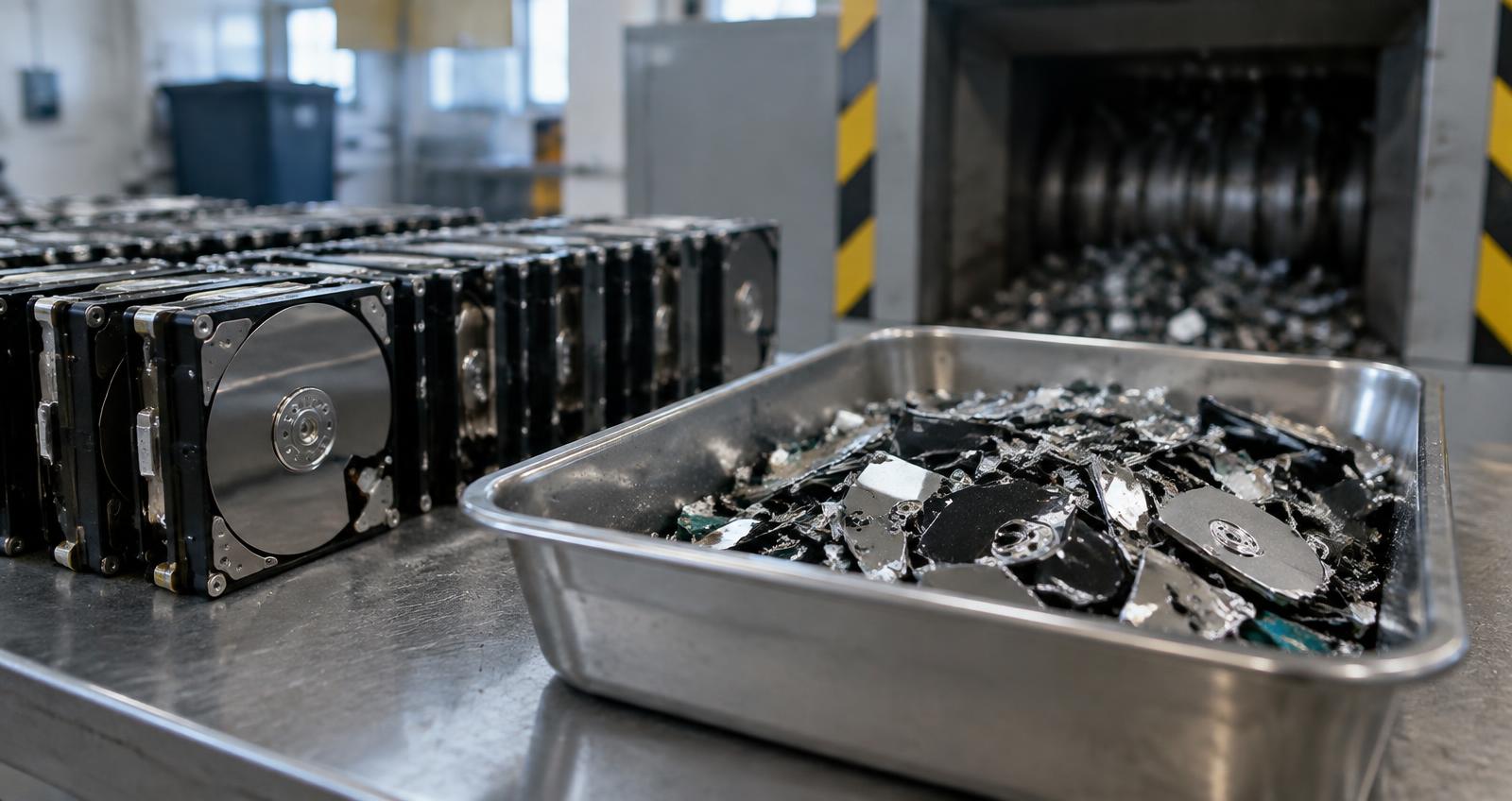
Three methods, one question: can the data ever come back?
Every credible method of retiring a drive answers the same question — is the data recoverable afterwards? Where they differ is cost, the type of drive they work on, and whether the hardware survives. Choosing the wrong one either wastes value or leaves you without a defensible audit trail.
1. Secure wiping (NIST 800-88 Clear and Purge)
Software-based sanitisation overwrites every addressable block, or triggers the drive's own firmware erase. Done properly and verified, the drive is safe to reuse or resell — which is exactly why the hardware keeps its value. For SSDs, a firmware-level Purge (cryptographic erase or secure erase) is the correct approach; multi-pass overwriting is a hard-drive habit that does little for flash storage.
Best for: working drives in laptops, desktops and servers you want refurbished rather than scrapped. See our plain-English guide to NIST 800-88.
2. Degaussing
A degausser hits magnetic media with a field strong enough to scramble the servo tracks. It works on spinning hard drives and on tape, and it is fast. Two caveats matter: the drive is dead afterwards (no value recovered), and degaussing does nothing to an SSD. Flash memory holds no magnetic charge, so a degaussed SSD still has every byte intact.
Best for: bulk magnetic media, particularly where a customer contract or classification scheme specifies it.
3. Physical shredding
Shredding reduces the drive to particles. It is the most visually reassuring method, and it is the right answer for failed drives that cannot be wiped, for SSDs where you want physical certainty, and for anything covered by a policy that demands destruction rather than sanitisation.
Best for: dead drives, high-sensitivity data, and cases where a witnessed destruction is required.
Choosing quickly
- Drive still works and has resale value? Wipe to NIST 800-88 Purge, verified.
- Drive failed, or will not report a successful erase? Shred it.
- SSD with sensitive data? Crypto-erase, or shred. Never degauss.
- Old magnetic tape archive? Degauss or shred — see our backup tape destruction guide.
The part auditors care about: evidence
Whichever method you choose, UK GDPR accountability rests on being able to show what happened. That means a serial-numbered record of every drive, the method applied, the date, and a signed certificate of destruction. A skip, a generic "recycled responsibly" email or a verbal assurance will not stand up if you ever need to demonstrate compliance.
How Byebyte handles it
We collect nationwide free of charge, log every drive by serial number, sanitise to NIST 800-88 or shred where sanitisation is not appropriate, and issue a serial-numbered certificate of destruction. Working drives that pass verification are refurbished, which is what funds the free collection. Everything else is recycled through WEEE-licensed channels with zero to landfill.
Ready to book? Arrange a free collection or read more about hard drive destruction in London.